Research and writing
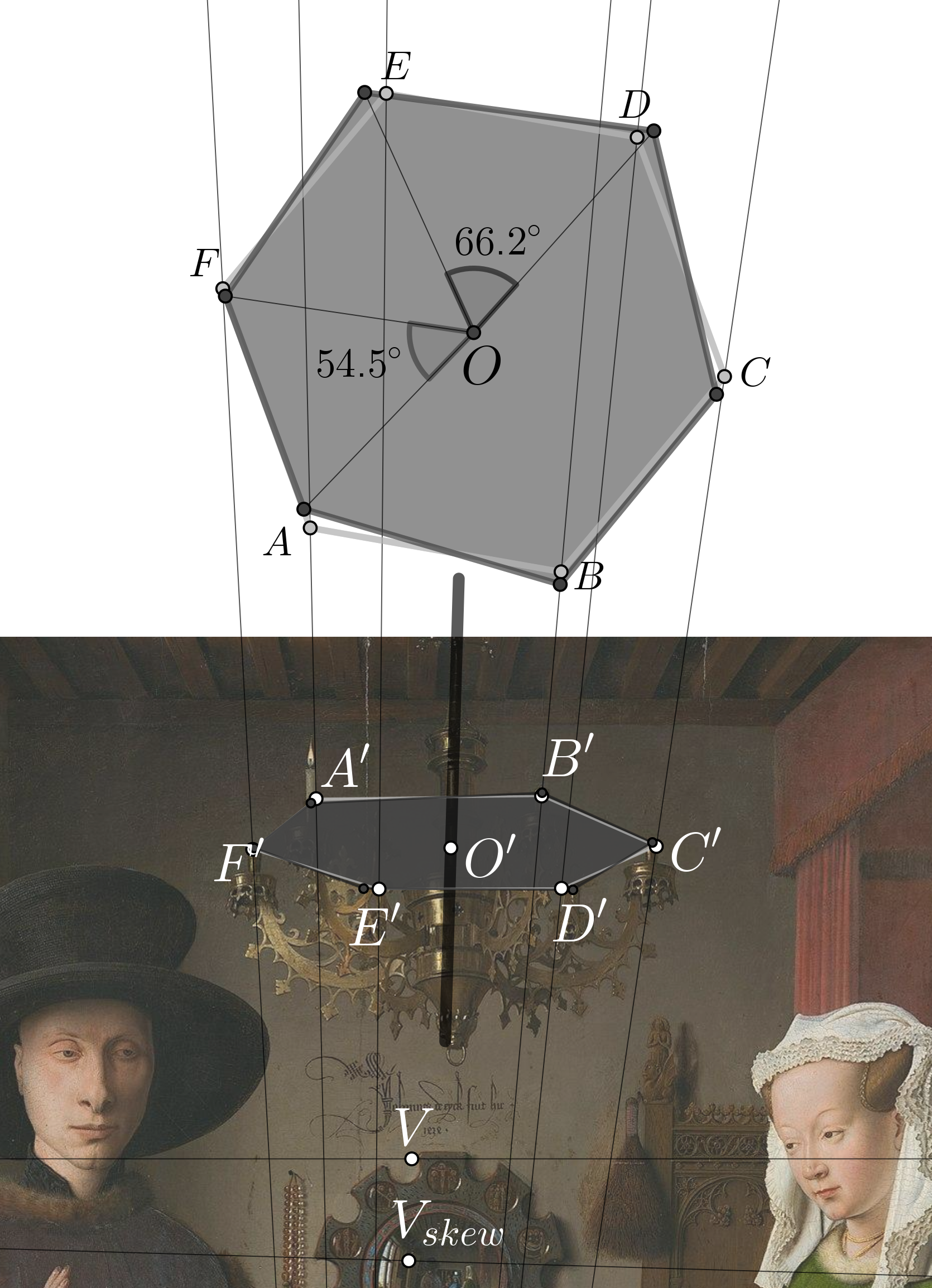
F. Futamura, O. Johnson, Jan van Eyck and the Painted Chandelier, J. Math. Arts, accepted, 2026.
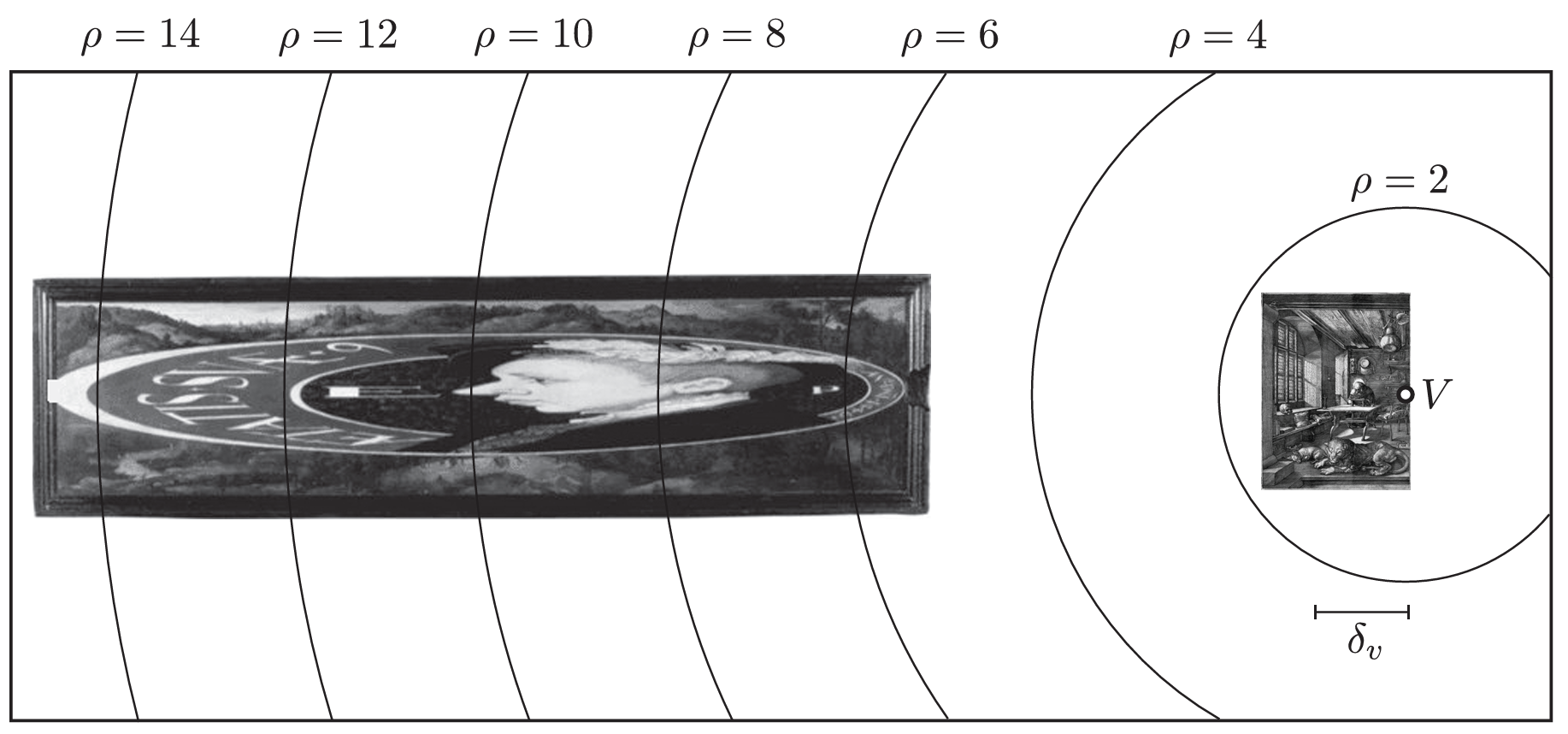
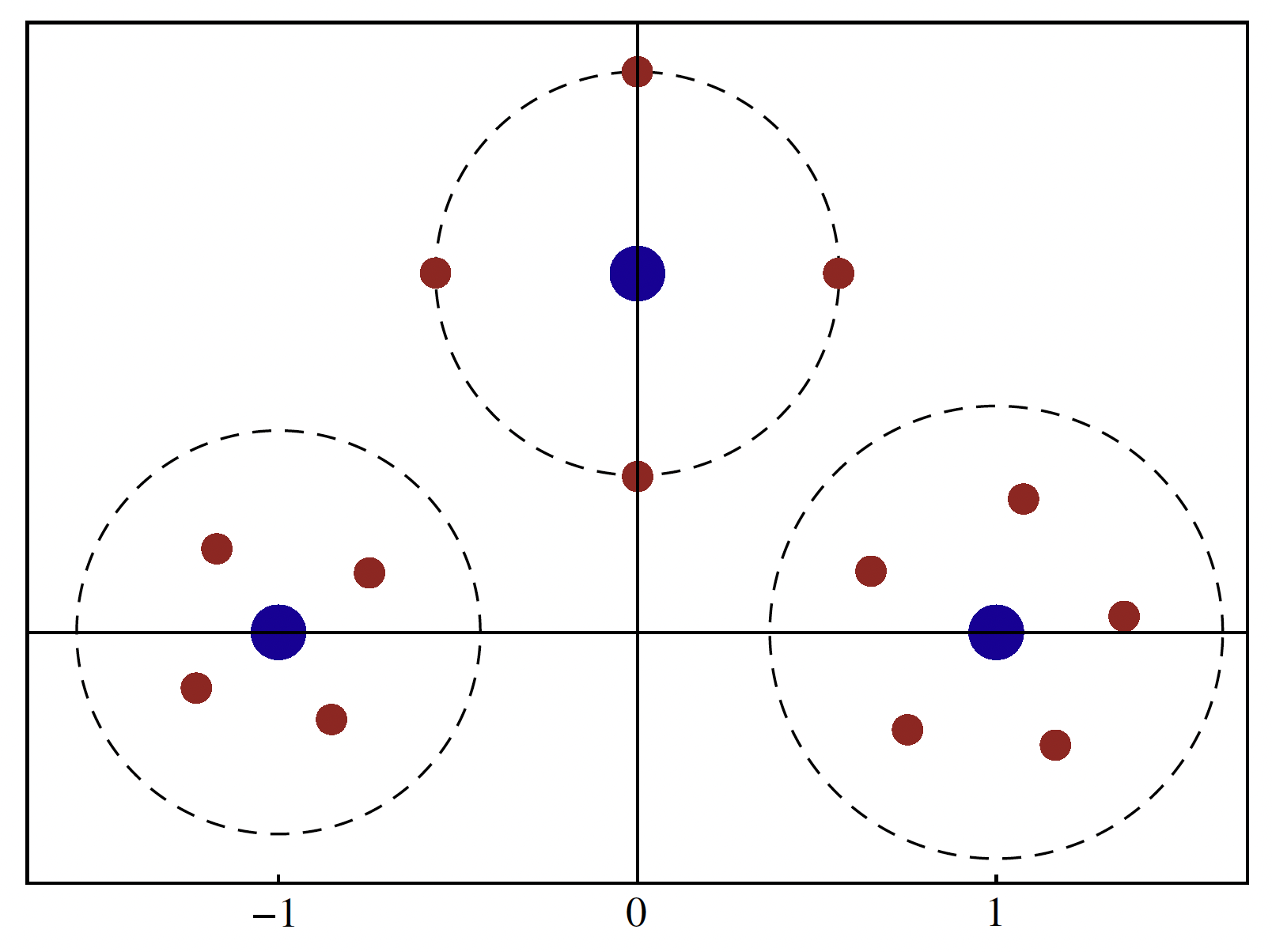
Co-authored with student Oliver Johnson, we dig deeper into the geometric evidence to support the Hockney-Falco thesis, that some paintings may have used an optical device to copy down forms, applied to Jan van Eyck’s The Arnolfini Portrait. We fit a projected, skewed hexagon model to the photorealistic six-armed chandelier compared to a photograph of a real chandelier and a painting of a chandelier that is known to be eyeballed.
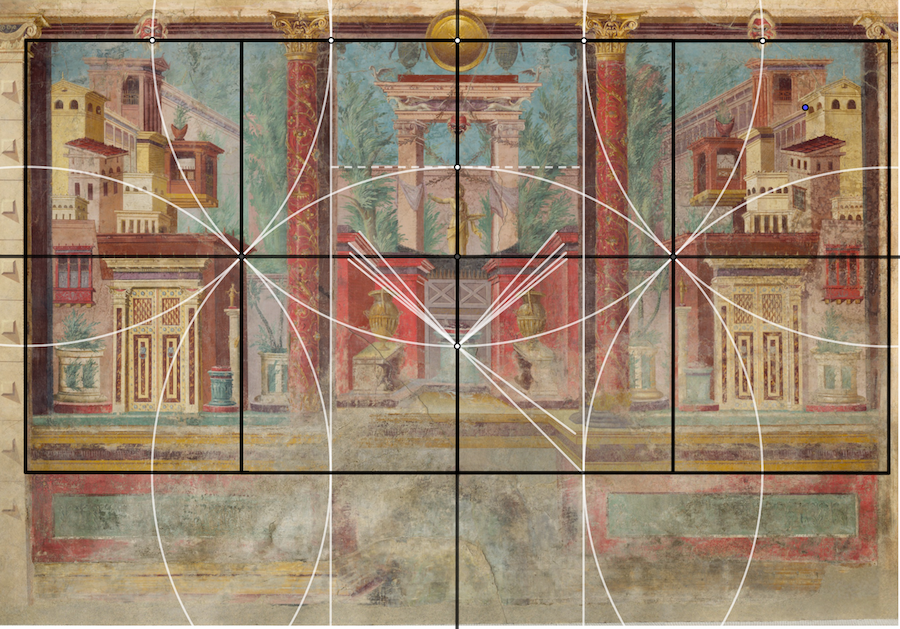
F. Futamura, Circles and Perspective in Ancient Roman Wall Paintings, Bridges conference proceedings, 2026.
I propose a new theory for how ancient Romans may have laid out the vanishing points and architectural and decorative elements in scaenographia, or scene paintings. From textual evidence and surface geometry, I show how simple compass and straightedge constructions used in other architectural layouts and designs appear to correspond well with important elements in the paintings.
S. Friday, F. Futamura, J. Smith, A. Waclawczyk, Powers of defective matrices from diagonalizable dilations, Linear Algebra Appl., 661 (2023), 202-221.
Co-authored with three students Sarah Friday, Jordan Smith and Aaron Waclawczyk, this paper looks at the idea of adding columns and rows to dilate a non-diagonalizable matrix to a diagonalizable one, but in such a way that the original eigenvalues are retained, the eigenvectors are predictable, and powers of the original matrix can be extracted from the powers of its dilation.
A. Crannell, M . Frantz, F. Futamura, An (isometric) perspective on homographies, J Geometry and Graphics, 23 (2019), no. 1, 65-83.
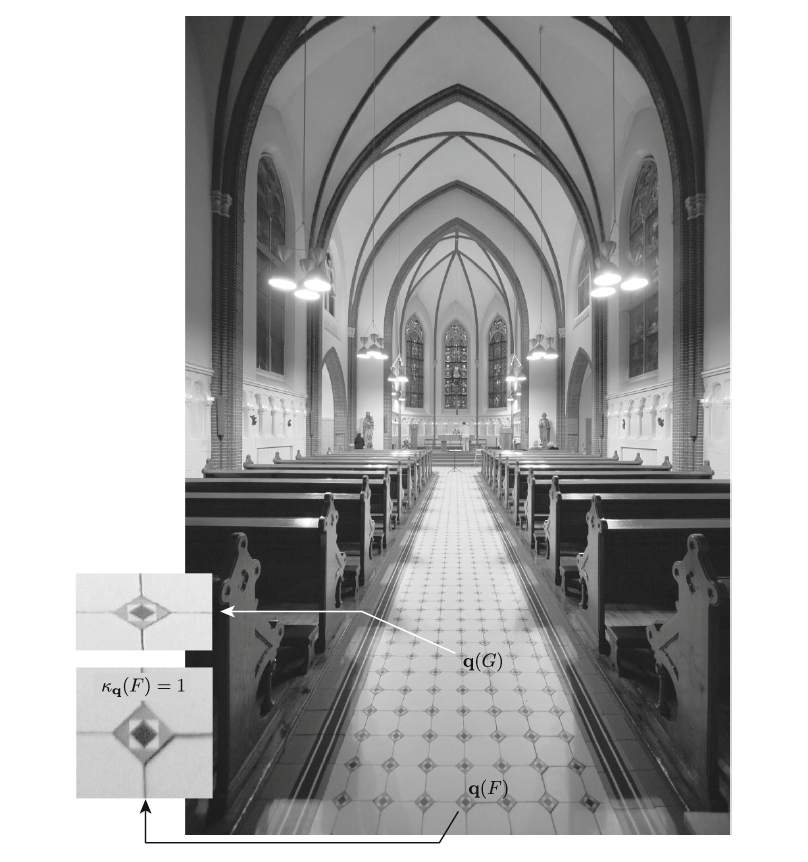
A. Crannell, M. Frantz, F. Futamura, Factoring a homography to analyze projective distortion, J Math Imaging Vis, 61 (2019), no. 7, 967-989.
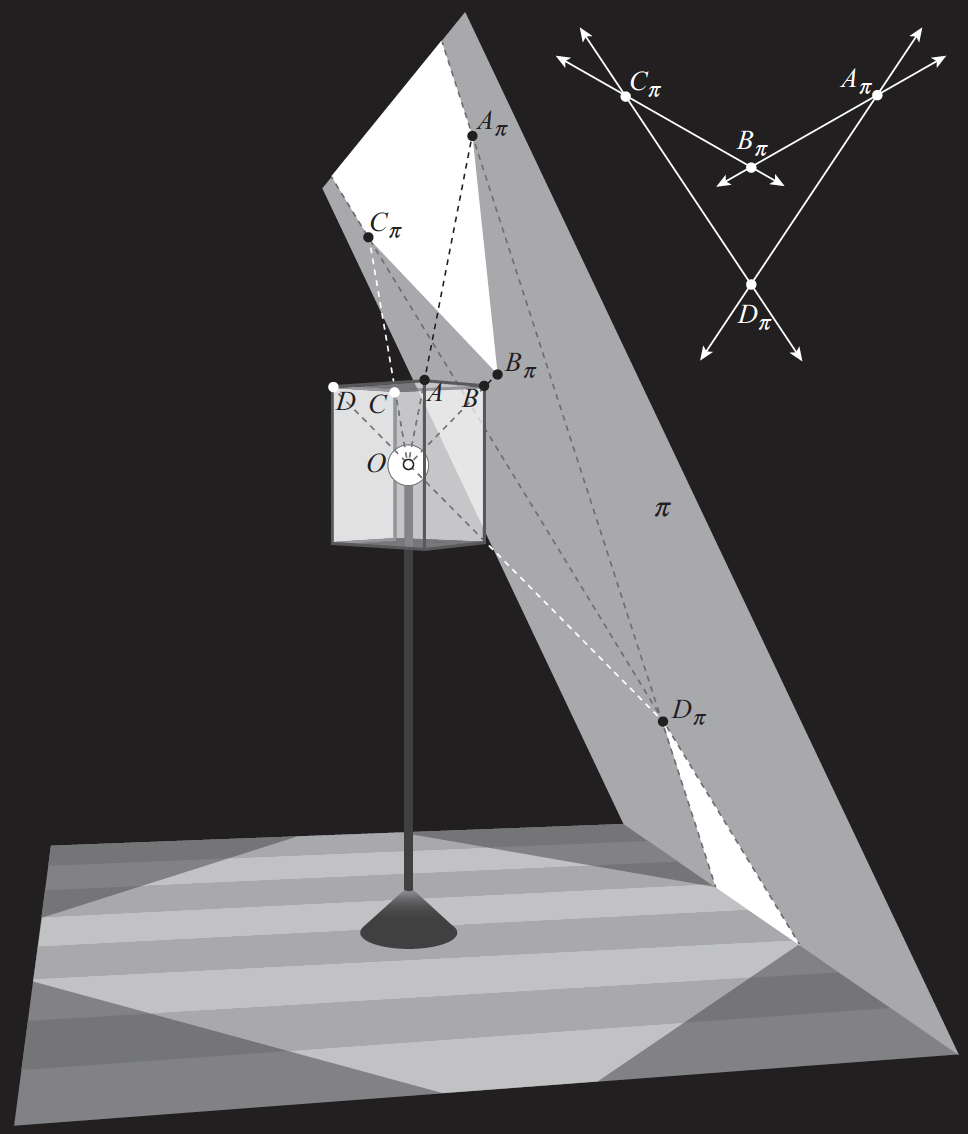
These two papers discuss the decomposition of homographies into a perspective collineation and a similarity, or in other words, showing how a particular transformation of an image called a homography can be understood to be a rotation, reflection, and/or dilation combined with a projection from a point of a flat surface to its image (like taking a photo of a picture).
F. Futamura, A. Marr, Taking Mathematics Abroad: A How-To Guide, PRIMUS, 28 (2018), no. 9, 875-889.
My colleague and I give some advice on how to teach mathematics abroad. We both taught in the SU London semester program, and taught classes like Applied Statistics, Cryptography Through the Ages, Mathematical Influences in Art and Victorian Mathematics and Society in Wonderland and Flatland.
SU news article: Math in Wonderland: Southwestern professor who sees math in art brings a new dimension to the Semester in London program, 2011
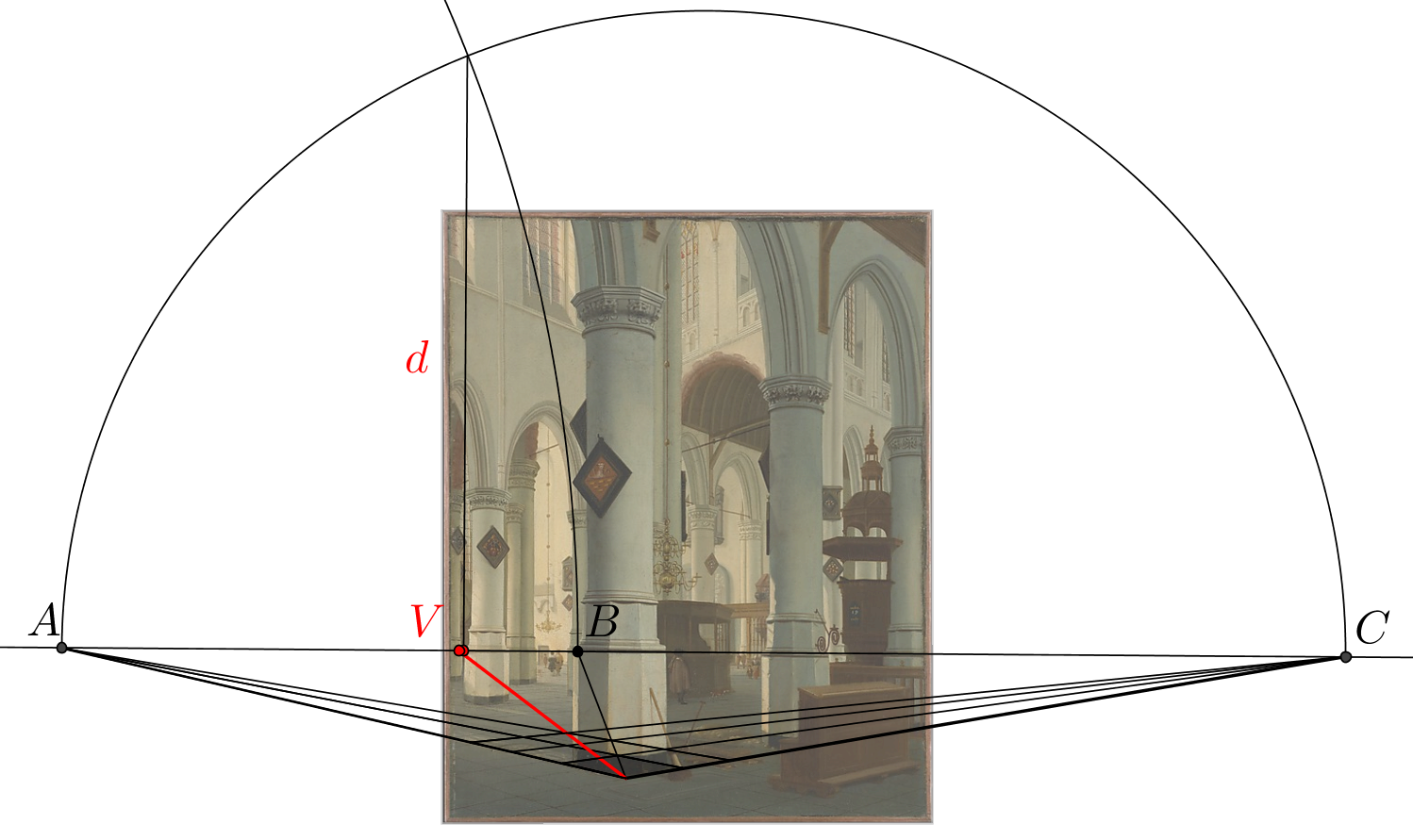
F. Futamura, R. Lehr, A new perspective on finding the viewpoint, Math Mag., 90 (2017), no. 4, 267–277.
This article co-authored with student Robert Lehr won the 2018 MAA Carl B. Allendoerfer Award for expository excellence of papers published in Mathematics Magazine in 2017. It describes a new method for finding the viewpoint for a two-point perspective drawing using the cross ratio.
SU news article: Southwestern Alum and Math Faculty Win Prizes for Coauthored Paper, 2018
A. Crannell, M. Frantz, F. Futamura, The image of a square, Amer. Math. Monthly, 124 (2017), no. 2, 99-115.
What can be the image of a square? More than you think.
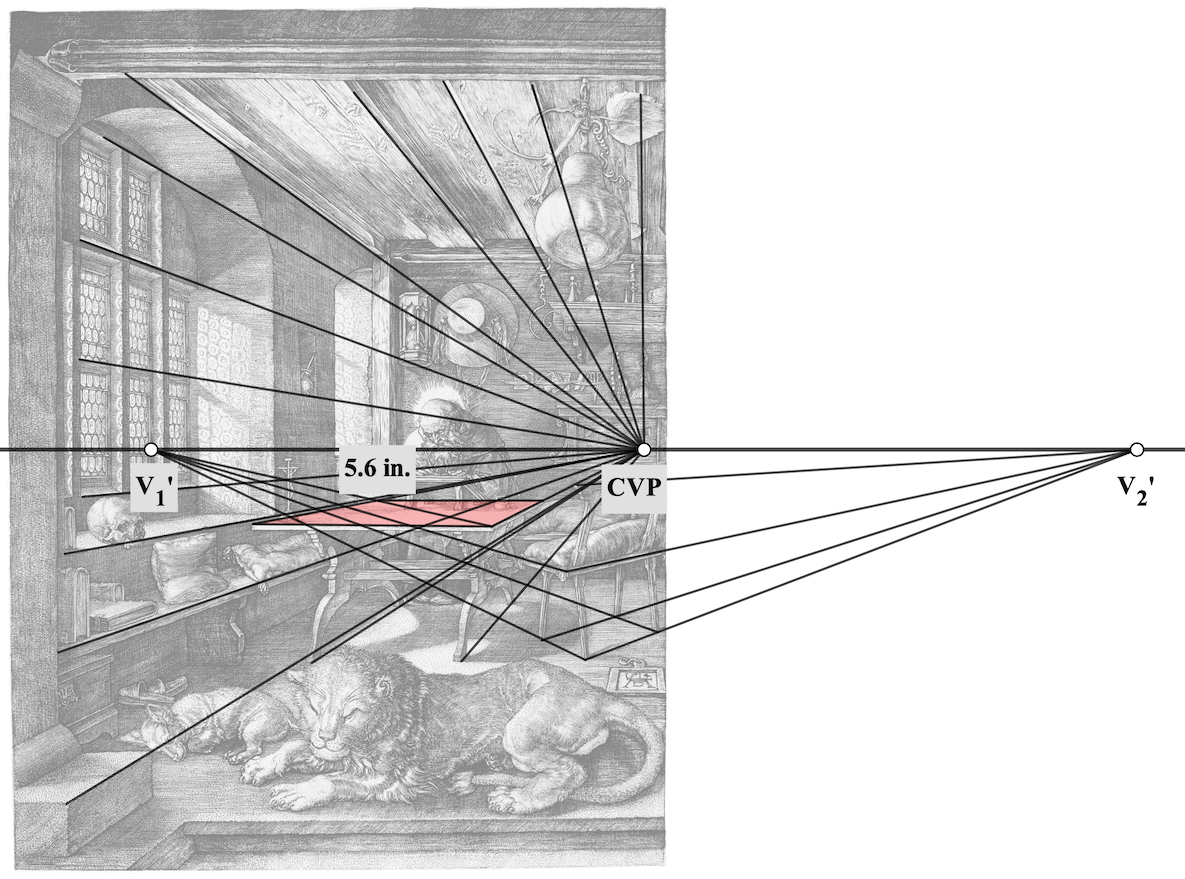
A. Crannell, M. Frantz, F. Futamura, Dürer: Disguise, Distance, Disagreements, and Diagonals! Math Horizons, 22 (2014), no. 2, 8–11.
This article was reprinted in: The Best Writing on Mathematics 2015, Princeton University Press. It vindicates the artist Albrecht Dürer, whose engraving St Jerome in His Study was eviscerated by the former director of prints at the Met William Mills Ivins Jr., on the 500th anniversary of the engraving.
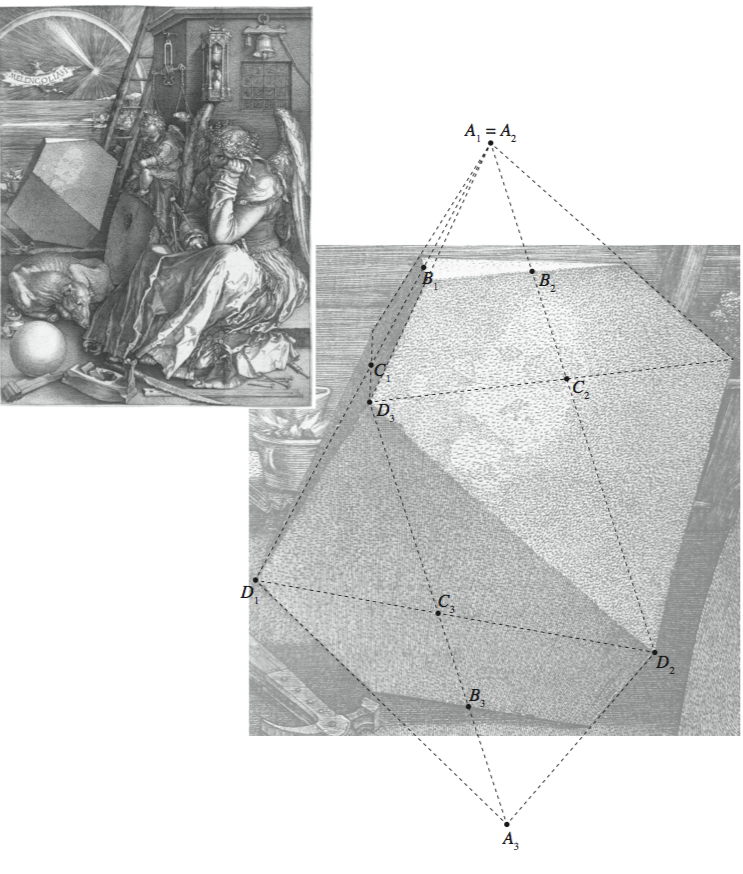
A. Crannell, M. Frantz, F. Futamura, The Cross ratio as a parameter for Dürer's solid (Party game for a 500th anniversary) J. Math. Arts, 8 (2014), no. 3-4, 111--119.
The shape of the mysterious polyhedron called Dürer’s solid in Albrecht Dürer’s engraving Melencolia I has been debated in dozens of papers for over a hundred years. We’ll never know his true intentions, but we give what we think is the best theory to date. On the shortlist of four papers considered for the 2016 JMA Outstanding Paper Award.
R. Denman, F. Futamura, K.C. Richards, On sharp frame diagonalization, Linear Algebra Appl., 438 (2013), no. 5, 2210-2224.
F. Futamura, Frame diagonalization of matrices, Linear Algebra Appl., 436 (2012), no. 9, 3201-3214.
These two papers introduce and explore the idea of frame diagonalization, using frames (spanning sets) rather than a basis of eigenvectors to diagonalize otherwise nondiagonalizable nxn matrices. We use a really cool theorem called Lidskii’s Theorem to make eigenvalues explode.
F. Futamura, Localizable operators and the construction of localized frames, Proc. Amer. Math. Soc., 137 (2009), 4187-4197.
F. Futamura, Symmetrically localized frames and the removal of subsets of positive density, J. Math. Anal. Appl., 326 (2007), no. 2, 1225–1235.
F. Futamura, Banach framed, decay in the context of localization, Sampl. Theory Signal Image Process., 6 (2007), no. 2, 151–166.
These three papers extend the notion of localized frames introduced independently by Gröchenig and the group Balan, Casazza, Heil, and Landau. These grew out of my Ph.D. dissertation under Akram Aldroubi.